State Seal State Seal State Seal
Home Button Home Button Home Button
 

Democratic News

{"removedFilters":"","searchUpdateUrl":"\/news\/democrat\/update-search","start":1376,"pageSize":11,"sort":"PublishDateDesc"}

COLUMBUS— The Ohio Black Maternal Health Caucus (OBMHC) is introducing a resolution this week to recognize Black Maternal Health Week in Ohio. Black Maternal Health Week (April 11-17) is an annual event that promotes awareness and seeks to advance and improve Black maternal health outcomes across the country.

Ohio House Minority Leader Emilia Strong Sykes is one of a select group of University of Florida alumni named to this year’s prestigious “40 Gators Under 40.” The annual awards program was established in 2006 to recognize alumni under the age of 40 whose achievements positively reflect The Gator Nation. Criteria for the competitive award include making a significant impact on the candidate’s industry and having civic or professional accomplishments at the state, national or international level.

House Minority Leader Emilia Strong Sykes (D-Akron) recognizes April 7th as World Health Day. Since taking effect in 1950, this day has been celebrated across the globe to create awareness for various health issues. Spanning from mental health, climate change, maternal and child care, and more, World Health Day provides an opportunity for countries to come together to focus on global health priorities. This year, the World Health Organization is pushing to eliminate health inequities in response to the COVID-19 pandemic. 

State Rep. Jessica E. Miranda (D-Forest Park) and State Senator Cecil Thomas (D-Cincinnati) announced the creation of the bicameral Ohio Gun Violence Prevention Caucus. An invite has been sent out to all Ohio House and Senate members to participate in the legislative caucus focused on advancing commonsense gun safety measures in Ohio.

State Reps. Dan Ramos (D-Lorain) and David Leland (D-Columbus) earlier this week announced the reintroduction of legislation that proposes Ohio join the National Popular Vote Interstate Compact, a group of states that pledge their entire Electoral College delegation to the winner of the national popular vote during the general election.

“This is a change that is long overdue. Two-thirds of the presidents elected in my adult life will have been chosen by the Electoral College in their first term without receiving the majority vote,” said Ramos. “Our current framework does not respect the direct will of the people. This is patently undemocratic and undermines confidence in the people that we are truly a democracy.”

State Rep. Casey Weinstein (D-Hudson) penned an OpEd in the Akron Beacon Journal this week in which he called for the repeal of Ohio’s new no duty to retreat law, which passed in December 2020 and is set to take effect Tuesday, April 6. Rep. Weinstein is a co-sponsor of legislation, House Bill (HB) 38, which would repeal the controversial law.

House Minority Leader Emilia Strong Sykes (D-Akron) today called on Statehouse leaders to repeal Ohio’s new no duty to retreat law, which passed in December 2020. Democratic-sponsored legislation, House Bill (HB) 38, would repeal the new shoot first law that takes effect Tuesday. 

State Reps. John Boccieri (D-Poland), Michele Lepore-Hagan (D-Youngstown) and Glenn Holmes (D-McDonald) last week wrote a letter to Gov. John Kasich urging him to preserve the revenue local governments and public transit systems receive from the Medicaid Managed Care Organization (MCO) tax. The federal Centers for Medicare & Medicaid Services (CMS) have given Ohio a deadline of June 30, 2017 to remedy its MCO tax structure so that it complies with CMS policy, but any changes may threaten the millions of dollars local communities currently receive from the tax. 

“Our concerns need to be heard on this issue and I want to work with the governor to include a fix to the MCO tax revenue in the upcoming state budget,” said Boccieri. “If local revenue sharing isn’t preserved, the legislature will cripple our communities with another unbearable budget hit.” 

House Minority Leader Emilia Strong Sykes (D-Akron) recognizes the month of April as Sexual Assault Awareness Month. Officially observed in 2001, this year marks the 20th anniversary, but the sexual assault prevention movement has its roots dating back to the early-mid 1900s with Black women and Women of Color at the forefront. Sexual Assault Awareness Month is aimed to spread awareness about sexual assault, harassment, and abuse. This year, the National Sexual Violence Resource Center is promoting the education of digital consent and how to create a safe space online.

As Americans reflect today on the impact and legacy of Reverend Dr. Martin Luther King, Jr., it’s important we remember one often understated piece of that historic legacy: the reverend’s resolute advocacy for economic justice.

Dr. King professed that economic opportunity is the foundation on which disenfranchised groups may achieve social and political empowerment. He understood that without a job or an income, a worker “has neither life nor liberty nor the possibility for the pursuit of happiness.”

With Ohio’s new no duty to retreat law set to take effect Tuesday, Democratic Reps. Adam C. Miller (D-Columbus) and Thomas West (D-Canton) today renewed their call to Statehouse leaders to pass House Bill (HB) 38, their legislation to repeal Ohio’s new “shoot first” law, which passed in December 2020.

State Rep. Michele Lepore-Hagan (D-Youngstown) today commented on the enactment of House Bill 463, legislation signed into law this week by Gov. John Kasich that will help communities fight blight by establishing an expedited foreclosure process for abandoned and vacant homes.

“Abandoned homes stuck in the lengthy foreclosure process can depress neighborhood property values and attract vandalism and crime,” said Lepore-Hagan. “Modernizing Ohio’s foreclosure laws helps stabilize neighborhoods and prevent urban decay by giving communities a tool to speed up the foreclosure process.” 

Today, Rep. Erica C. Crawley (D-Columbus) issued a statement urging U.S. Treasury Secretary Janet Yellen to ensure that the distribution of federal funding from the recently passed American Rescue Plan (ARP) be eligible to towns and townships across the country, including Ohio’s more than 1,300 townships. She said making ARP funds available to townships is crucial to Ohio’s recovery from the coronavirus pandemic.

In what proved to be an unpredictable year for government and politics across the nation, Ohio House Democratic Leader Fred Strahorn (D-Dayton) says his caucus found both challenges and successes in the Buckeye State. 

From helping to stop sweeping unemployment insurance cuts – at the beginning of 2016 and again at the end of legislative session in Dec. – to fighting back against GOP-led, eleventh-hour lawmaking that brought to the governor’s desk government shutdown legislation; sweeping intrusions on a woman’s sovereignty to make her own healthcare decisions; and a toppling of several self-government principles in Ohio, Democratic lawmakers have faced a busy, and at times contentious, legislative session in 2016. 

This year also saw members from both parties come together, something Strahorn believes was productive, to successfully take on issues like medical marijuana, charter-school reforms and infant mortality. That approach, the Leader says, was also helpful in tempering tax shifting proposals, attacks on working people and cuts to school funding. 

“It is easy for a party that controls every aspect of state government to get sidetracked with initiatives that are heavy on politics and light on good public policy, but by keeping communication open and standing up for fundamental American values when they are threatened, we have been effective in influencing legislation and having a credible voice in policy debates,” said Strahorn. 
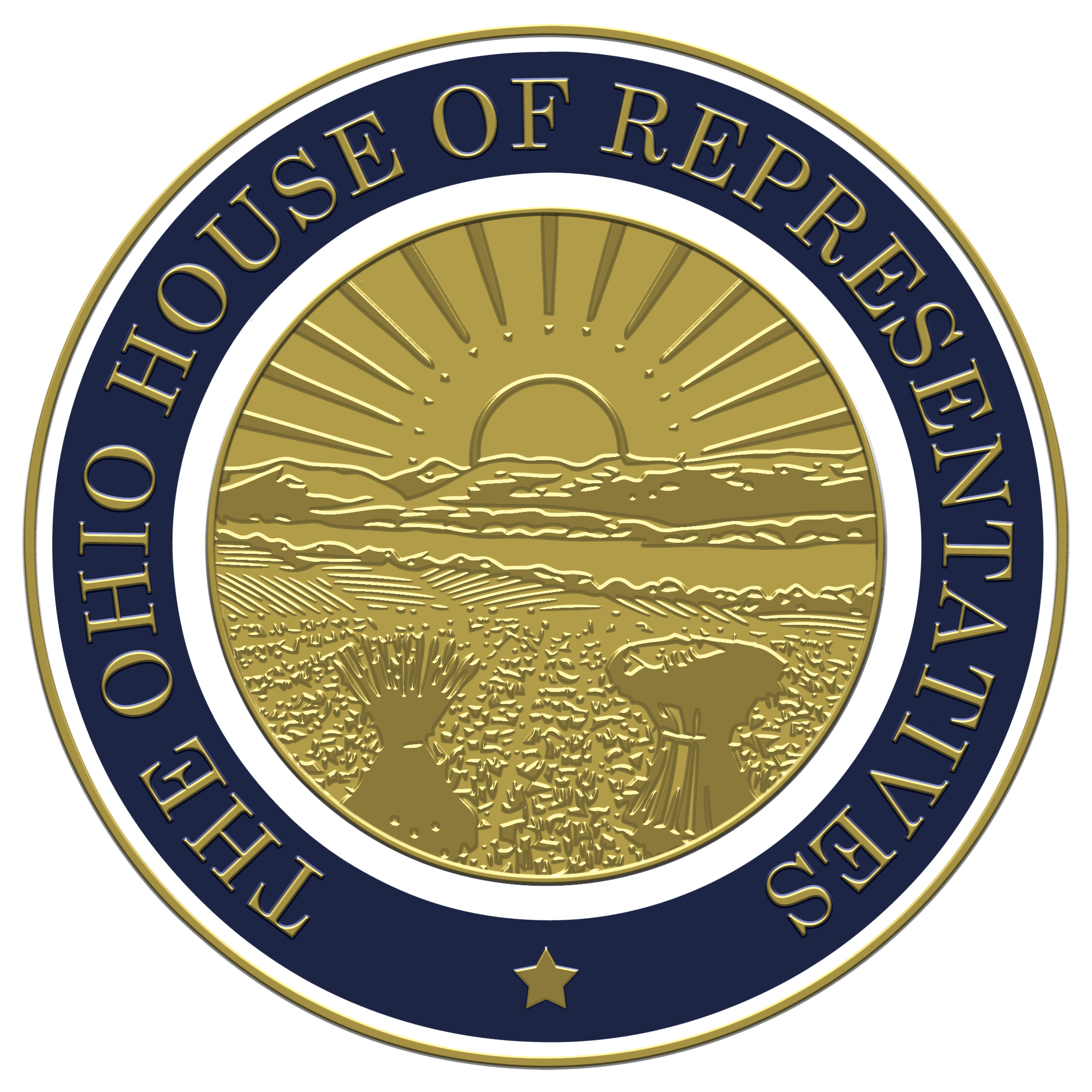
House Minority Leader Emilia Strong Sykes (D-Akron) today received a coronavirus vaccine while touring a vaccination site in Akron. During her visit alongside Gov. Mike DeWine, Leader Sykes thanked medical staff and personnel for their work throughout the pandemic and urged every Ohioan to sign up for a vaccination appointment. The state opens vaccination to anyone 16 years old and over beginning Monday, March 29.

State Reps. Michael P. Sheehy (D-Oregon) today sent a letter to Governor Kasich urging him to veto House Bill (HB) 554, legislation that dramatically changes the state’s energy efficiency standards to unenforceable “goals” for the next three years.

“This legislation will undermine the economic and job growth of advanced energy businesses like First Solar in northwest Ohio,” said Sheehy. “Other leading businesses across the nation – and the globe – are turning to renewable energy sources to power their state-of-the-art 21st century facilities. Leading companies such as Apple, Coca-Cola Enterprises and General Motors have all publicly pledged to produce one-hundred percent of their electricity from renewable energy sources.”

Ohio House Democratic Leader Fred Strahorn (D-Dayton) today applauded Gov. John Kasich’s veto of House Bill 493, legislation that would ban abortions in the state once a fetal heartbeat is detected, as early as five to six weeks. The House leader also commended today’s Montgomery County Common Pleas Court Decision against the Ohio Department of Health (ODH), effectively keeping the Women’s Med Center of Dayton open. 

“At a time when people feel uncertain about the future of their healthcare, Ohio should be doing everything it can to increase access to care, not limit it with roadblocks that have been found to be unconstitutional,” said Strahorn. “Despite today’s mostly positive news, too many women across our state still face barriers to care and politicians who want to intrude on healthcare decisions best left to women in consultation with their families, faith and physicians.” 

In an early Friday morning House session, the Republican-controlled House rubber stamped a sweeping bill that could shut down state government by giving the legislature new power to dissolve executive-branch state agencies. The bill, Senate Bill 329, would force some 25 state agencies every four years to spend extra money and resources to defend against elimination based on a number of factors, including the potential for privatization, and a regulations evaluation against other states. 

“Not only is this sweeping transference of power an extreme and troubling departure from the American democratic foundation of checks and balances, but it puts Ohioans in danger by potentially shutting down essential services overnight,” said House Democratic Leader Fred Strahorn (D-Dayton). “This would create chaos within our state and could lead to outsourcing primary functions of the state like education, public safety, public health and workers’ compensation. It is nothing more than a power grab under the cover of night and guise of review.” 

State Reps. John Rogers (D-Mentor-on-the-Lake) and Bob Cupp (R-Allen County) today announced the Senate passage of House Bill 436, legislation to address an inconsistency in state law with regard to OVI license suspension and offender vehicle mobilization.  

HB 436 previously passed unanimously in the Ohio House in March and in the Senate Transportation Commerce and Labor Committee last week. 

“This bill is the product of consultation with some of my friends in the judicial branch, including Mentor Municipal Court Judge Trebets,” said Rogers. “They came to me explaining this issue, which I recognized to be an issue from my many years as a prosecutor.” 

House Democratic lawmakers today heralded the passage of Senate Bill 27, legislation to ensure firefighters disabled by cancer as a result of their hazardous line of work are eligible for benefits from the workers’ compensation fund and the Ohio Police and Fire Pension Fund.

“The first responders who keep us safe shouldn’t face medical uncertainty or financial instability after years of selfless sacrifice,” said Assistant Democratic Leader Nicholas J. Celebrezze (D-Parma). “That’s why this reform ensures our everyday heroes don’t have to go it alone.”

Research conducted by the National Institute for Occupational Safety and Health (NIOSH) has found that firefighters show higher rates of certain types of cancer than the general U.S. population as a result of occupational exposure. The study also found that the chance of a lunch cancer diagnosis or death for a firefighter increases with the amount of time spent at fires, while the chance of leukemia death increases with the number of fire runs.