Democratic News
Featured Stories
News Feed
The House Finance Committee Wednesday passed the latest version of the Fair School Funding Plan, House Bill (HB) 305, bipartisan legislation sponsored by Reps. John Patterson (D-Jefferson) and Gary Scherer (R-Circleville) that would transform the way Ohio’s schools are funded. Supporters say the plan would address many of the issues that have plagued the state’s funding formula, which the Ohio Supreme Court has found unconstitutional four times, beginning with the DeRolph decision in 1997.
State Rep. Stephanie Howse (D-Cleveland) today applauded the consent decree negotiated between the City of Cleveland and the federal Department of Justice, saying the agreement is an important step toward achieving real progress on community-police relations in Cleveland.
Announced at a joint press conference this afternoon, the ground-breaking agreement between the city and federal justice officials includes provisions on community engagement, use-of-force, support and resources, minimizing stereotyping, accountability and crisis intervention. In particular, the agreement enables Cleveland to continue its city-wide implementation of body cameras for all officers and establishes a new community police commission that will work with neighborhoods to provide input into police matters.
“The reforms being implemented in Cleveland will make our officers better equipped to perform their duties while ensuring fair treatment for all city residents,” said Howse. “With the cooperation of federal authorities and local and state leaders, this brings us closer to significant justice reform in our community and state.”
State Reps. Greta Johnson (D-Akron) and Teresa Fedor (D-Toledo) held a news conference today calling for changes to state laws that prevent equal justice for all survivors of rape. The lawmakers are pushing for the elimination of the statue of limitations on all rape cases in addition to making spousal rape and sexual battery illegal in Ohio.
According to the Centers for Disease Control and Prevention, more than one in three women experience rape or other physical violence at the hands of an intimate partner in their lifetime.
“This is a constitutional response to an unconscionable problem,” said Johnson. “With every day that passes, another victim of rape or sexual assault is denied access to justice and sexual predators are allowed to roam freely. We will not rest until all victims of sexual violence have equal and unfettered access to justice in our state.”
Victims of rape or sexual violence who seek justice can be prevented from doing so if the statute of limitations has passed by the time the victim is capable of reporting the crime and pursuing charges. While the two women lawmakers commended the recent passage of House Bill 6, which extends the statute of limitations on all rape cases for an additional five years, they believe that Ohio should join the growing number of states where spousal rape is illegal and there is no limit to charging perpetrators of sexual assault.
“Women want to live in a state where they feel safe and are treated equally under the law,” Rep. Fedor said. “It is past time to do away with laws that prevent Ohioans from seeking justice for sexual violence. We need to have a serious conversation in our state about these commonsense reforms that will ensure survivors equal access to justice and put criminals and rapists behind bars.”
COLUMBUS— Rep. Catherine Ingram (D-Cincinnati) voiced concerns over the House passage of Senate Bill (SB) 40 Wednesday, which would enact the “Forming Open and Robust University Minds Act” regarding free speech on college campuses.
House Democratic Leader Fred Strahorn (D-Dayton) today issued the statement below in response to Gov. Kasich’s plan to kill collective bargaining for workers who help Ohio’s elderly, disabled citizens and children.
State Reps. John Boccieri (D-Poland) and Michele Lepore-Hagan (D-Youngstown) sent a letter to state Rep. Andrew Brenner (R-Powell), Chair of the House Education and Career Readiness Committee, requesting an investigation into the effectiveness of the Youngstown Plan, which was created in House Bill (HB) 70 in 2015. Under the plan, the state assumed control of the Youngstown City School District, eliminated the school board and appointed a CEO to oversee all operations of the district. The letter comes amid the resignation of three Academic Distress Commission members and the potential departure of Youngstown City School District CEO, Krish Mohip.
“The rushed legislation that instituted the Youngstown Plan under HB 70 in the last biennium now causes a need for an investigation,” the Mahoning Valley lawmakers wrote.
Boccieri and Lepore-Hagan are scheduled to meet with Brenner and a member of the Academic Distress Commission in Youngstown on Monday, April 16.
*Editor’s note: A copy of the letter is attached
Ohio Legislative Black Caucus (OLBC) President and State Rep. Alicia Reece (D-Cincinnati) joined OLBC members today to call for justice reform and to urge the governor to release an action report on executive efforts toward reform in Ohio. The justice reform agenda* developed by the OLBC aims to guide state and community efforts in dialogue and action between communities of color and the state justice system.
“Public outcry and civil unrest following the police-led deaths of unarmed African American men has started a new public dialogue surrounding police-community relations and the need for justice reform immediately in Ohio and throughout the nation,” said Rep. Reece. “We need to take hold of a moment in time when Americans and Ohioans are crying out for meaningful justice reform that keeps us safe, treats citizens fairly and restores faith in our justice system. Now is the time to take action for real justice reform.”
In the wake of Ohio Republican lawmaker Niraj Antani’s public comments suggesting students should arm themselves in high schools across the state, state Rep. Teresa Fedor (D-Toledo) today issued the following statement:
“To suggest students should carry guns at school is to turn our backs on our constitutional oath to further a free society where students have an equal opportunity to succeed. Arming students in the 21st century violates every shred of commonsense, responsible lawmaking, and is better saved for oppressive regimes in foreign lands – not America.
“We should be deeply troubled and angered by politicians who suggest arming students is an appropriate response to the national discussion on commonsense ways to reduce gun violence in our nation. Too many politicians have robbed our students of a childhood by failing to keep them safe, which has pushed them out of our schools and into the streets to fight for accountability from their elected officials. It’s clear some politicians still aren’t listening.”
The Ohio House Democratic Caucus today announced its leadership team for the 134th General Assembly. In an all-caucus vote, Democrats re-elected Rep. Emilia Strong Sykes (D-Akron) as Minority Leader.
State Reps. David Leland (D-Columbus) and Kristin Boggs (D-Columbus) last week introduced legislation to keep Ohio’s drinking water clean and safe by preventing the destruction of natural buffer zones around drinking-water reservoirs, like the Hoover Reservoir in Franklin County.
“The Hoover Reservoir is a vital source of public water for Columbus, and the strip of land encircling Hoover and other reservoirs acts as a natural filter that removes contaminants that would threaten our water supply,” said Leland. “This provision, which was inserted into the previous state budget at the last minute without public input or participation, is a potential threat to the health and safety of all Franklin County residents.”
State lawmakers today held a joint session of the Ohio House and Senate to honor military members and their families at the annual Ohio Military Medal of Distinction Ceremony and Wreath Laying at the Ohio Statehouse. This year’s ceremony posthumously honors six servicemen from across Ohio who gave their lives in service of their country. The annual ceremony is held in celebration of Memorial Day and honors the courage, dedication and sacrifice of Ohio’s service members.
“It is a tremendous honor to take part in paying tribute to the brave soldiers who gave their lives defending our freedom,” said Columbus Rep. Hearcel Craig, the top Democratic member of the House Veterans Affairs Committee. “This ceremony sends an important message to service members everywhere that we are forever grateful for their valor, courage and service to our state and nation. Elected officials must also use this observance to further our sense of duty to fight for good-paying jobs and access to healthcare services for our returning soldiers.”
The Ohio Military Medal of Distinction was created in 2009 to honor fallen service members killed after Sept. 10, 2001, while fighting in combat zones or engaging in U.S. military operations. Both chambers of the Ohio legislature meet annually to recognize these individuals and their families and to pay tribute to their ultimate sacrifice.
“Throughout our nation’s history of defending freedom and fighting tyranny and injustice, Ohioans have always answered the call to serve their country and state,” said Democratic House Leader Fred Strahorn (D-Dayton). “Their service and sacrifice is a reminder to us all that we owe our brave men and women so much more than what can be offered through a ceremony or special recognition. That is why we must continue fighting for our men and women in uniform to have the opportunity for a better life when they return home. We must heed t
On the heels of the first state Oil and Gas Commission meeting Thursday, state Rep. David Leland (D-Columbus) today introduced legislation that would protect Ohio’s parks and nature preserves from the impacts of fracking. The proposed bill will ensure adequate protections for Ohio’s state and local parks by refusing any new well permits for lands typically enjoyed by families and people who enjoy the outdoors.
“It is my hope that we can all share a vision for our state that includes meeting our energy needs without ever having to sacrifice our beautiful state and local parks, forests, nature preserves, and wildlife areas,” said Leland. “Conserving Ohio’s public lands ensures they will be around for future generations to utilize and enjoy.”
This year’s state-budget-veto showdown between Gov. Kasich and Ohio House Republicans resulted in the appointment of members to the vacant Oil and Gas Commission, which is responsible for issuing drilling licenses for state lands. The commission held its first meeting Thursday in Columbus.
The footprint and disruption of fracking, or horizontal drilling, is much larger than conventional oil and gas wells, raising additional concerns over habitat fragmentation and wetland destruction. Fracking also typically costs Ohio’s communities much more in added cleanup, greater wear and tear on roads, and significant emergency response needs.
Ohio House Minority Leader Emilia Strong Sykes (D-Akron), today sent a letter calling on Governor Mike DeWine to veto Senate Bill (SB) 311, legislation Democrats say will slow the state’s coronavirus response, ultimately leading to more deaths and further destabilizing Ohio’s economy. Statehouse Republicans fast tracked SB 311 last week, voting along party lines to pass the controversial bill that would strip executive power from the state’s Health Director during public health crises. The bill now awaits the governor’s signature.
State Rep. Emilia Strong Sykes (D-Akron) today announced the introduction of House Bill (HB) 1, bipartisan legislation to modernize Ohio’s dating violence laws. The bill is modeled after HB 392 of the 131st General Assembly, legislation that passed the House unanimously last spring and as an amendment during the lame duck session. House Bill (HB) 1, co-sponsored by Rep. Nathan Manning (R-N. Ridgeville), would allow victims of dating violence to obtain civil protective orders against their attacker, a protection not allowed under current Ohio law.
“It is past time we pull Ohio out of the dark ages by modernizing our laws to protect all victims who are impacted by dating violence,” said Sykes. “By allowing this measure to become House Bill 1, we are sending a clear message that now is the time to close the loophole in Ohio’s dating violence laws. With every day we wait, more women and men in Ohio are placed in serious danger.”
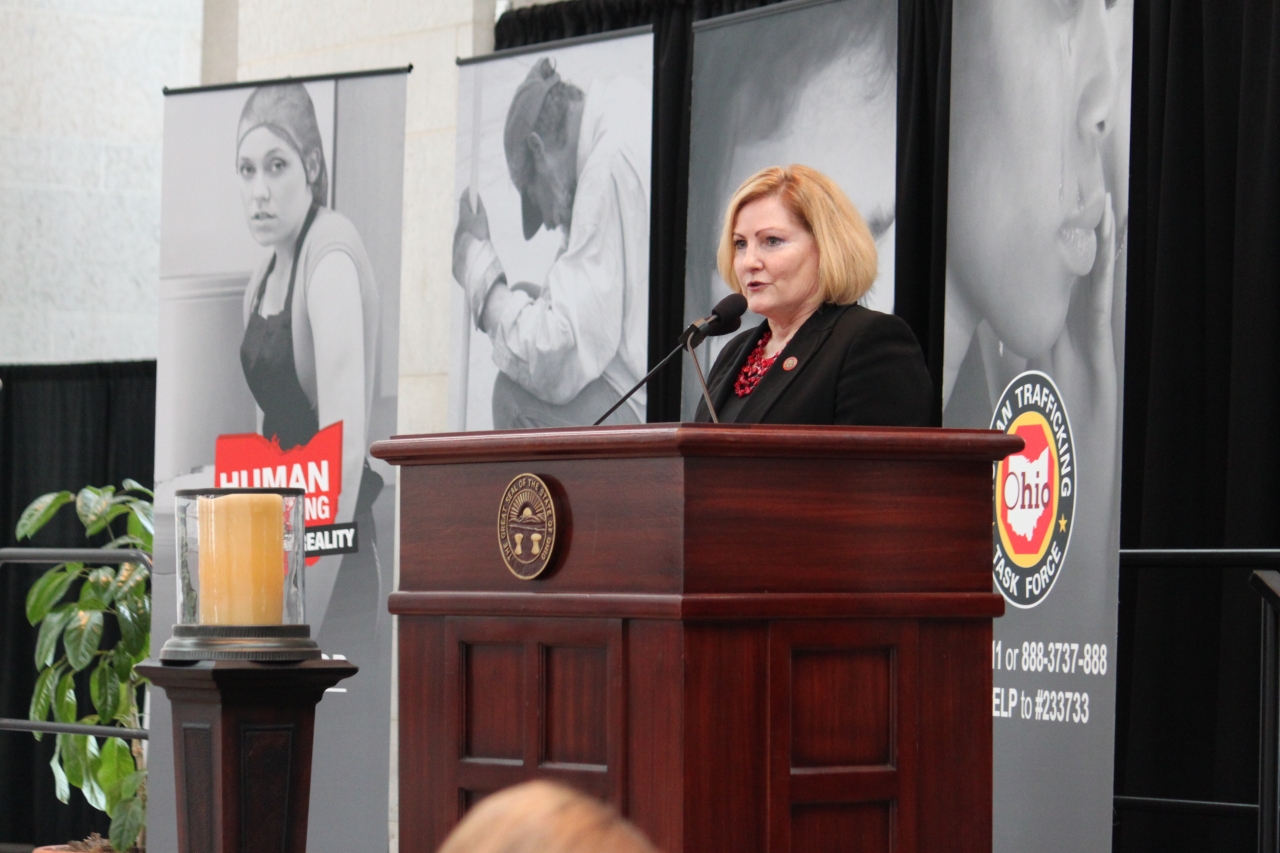
State Rep. Teresa Fedor (D-Toledo) hosted the Eighth Annual Human Trafficking Awareness Day today at the Ohio Statehouse, as lawmakers, law enforcement officials, advocates and survivors from across the state and nation gathered for a day of discussion on ways to raise awareness and fight back against human trafficking in Ohio.
“While we have made great strides at the state level to halt the spread of human trafficking, we cannot let up now. Law enforcement, advocates, families and survivors must continue to work together to raise awareness and protect vulnerable men and women from being ensnared by modern day slavery,” said Fedor. “I am confident that by bringing diverse voices from all across the state to the same table, we can make positive progress toward finally ending human trafficking in our state.”
State Rep. Teresa Fedor (D-Toledo) will host the eighth annual Human Trafficking Awareness Day on Thursday, February 2 from 8:30 a.m. to 4:30 p.m.at the Ohio Statehouse Atrium. The annual event will bring together law enforcement officials, advocates, experts and survivors for interactive educational workshops and informational and inspirational presentations regarding ways to raise awareness and fight back against human trafficking in Ohio. This year’s special guest is Dr. Elaine Richardson, an author, artist and inspirational professor.
“I believe that by bringing diverse voices from all across the state to the same table, we can help raise awareness and collaborate on strategies to combat modern day slavery,” said Fedor. “While we have made great strides at the state level against the spread of human trafficking, the real work is done out in the community by law enforcement, advocates, families and survivors.”
This year’s event will also include the first ever Ohio Youth Trafficking Prevention Summit focused on prevention and protection strategies for young people on Friday, February 3 from 9:30 a.m. to 2:30 p.m.
“Unfortunately, human traffickers often target young and vulnerable children,” said Fedor. “By educating our youth on prevention and protection strategies, I believe we can help keep our children safe from predatory criminals.”
The youth summit is free to attend but tickets are required. Those interested can register at: https://www.eventbrite.com/e/8th-annual-ohio-human-trafficking-awareness-day-youth-summit-tickets-28770533440
For the past ten years, Rep.
Today, Franklin County representatives Assistant Minority Leader Kristin Boggs (D-Columbus), Assistant Minority Whip Richard Brown (D-Canal Winchester) and State Reps. Adam Miller (D-Columbus), Mary Lightbody (D-Westerville), David Leland (D-Columbus), Dr. Beth Liston (D-Dublin), Allison Russo (D-Upper Arlington), and Erica Crawley (D-Columbus) reacted to House passage of a bill (Senate Bill 311) to undermine the director of health’s authority at a time when the state has reached a dangerous peak, with Franklin County being the first county designated purple status. Announced by Gov. Mike DeWine Thursday, Franklin County is the first in the state to be elevated to purple status since the state began using this alert system.
Ohio House Democratic lawmakers today sent a letter to Ohio Department of Medicaid Director Barbara Sears, during the agency’s public comment period, calling on the agency to rethink controversial and partisan Medicaid restrictions. The new restrictions would deny some qualifying Medicaid recipients their healthcare without notice if they cannot work a specified number of hours in a given month.
Ranking Democrat Rep. Brigid Kelly (D-Cincinnati) today issued a statement as the House State and Local Government Committee voted to fast track Senate Bill (SB) 311, which would curb executive authority from the state health director to issue orders during public health emergencies like the coronavirus pandemic.
The lead Democratic legislator on the state’s budget and finance panel, state Rep. Jack Cera (D-Bellaire), released the following statement in response to today’s state budget unveiling:
“Trickle-down tax promises of the last six years haven’t come true, and it’s dangerous to expect they will by shifting even more taxes onto working people. As our nation grows and realizes new opportunities since the recession, Ohioans have been running in place instead of getting ahead. We don’t just need to bring Ohio back from the recession - we need to make Ohio first in growth and opportunity. The economic underpinnings of this budget represent the governor’s plans from the past, not a plan for our future.
Ohio House Democratic Leader Fred Strahorn (D-Dayton) released the following statement in response to today’s state budget unveiling:
“Though Governor Kasich has said Ohio is on the verge of a statewide recession, his budget proposal is largely built on the same failed economic ideology that has been holding Ohio back from sharing in the economic growth and stability our nation has experienced since the recession. Tax shifting from the wealthy few to the working and middle class has sidelined Ohio, and predictably failed to bring back middle-class jobs.
<p>Democratic state lawmakers today unveiled an ambitious economic agenda focused on laying a foundation for economic stability and paving a path to the middle class for the next generation of working people in the state</p>
Ohio House Democratic Whip Nickie Antonio (D-Lakewood) issued the following statement today in response to a ruling by U.S. District Court Magistrate Judge Michael Merz that declared Ohio’s new three-drug lethal injection process unconstitutional. Merz also indefinitely suspended three planned executions of Ohio inmates, including one scheduled in February.
“When the proposed drugs for lethal injection are found to be unconstitutional because they may cause ‘substantial risk of serious harm’, it is immoral for the state to continue to fight to use them,” said Antonio. “I believe it is long past time we abolish the death penalty in Ohio and replace it with a sentence of life without parole.”
State Reps. Dan Ramos (D-Lorain) and David Leland (D-Columbus) earlier this week announced the reintroduction of legislation that proposes Ohio join the National Popular Vote Interstate Compact, a group of states that pledge their entire Electoral College delegation to the winner of the national popular vote during the general election.
“This is a change that is long overdue. Two-thirds of the presidents elected in my adult life will have been chosen by the Electoral College in their first term without receiving the majority vote,” said Ramos. “Our current framework does not respect the direct will of the people. This is patently undemocratic and undermines confidence in the people that we are truly a democracy.”
Ohio Democratic state lawmakers, workers and advocates today announced a bill to address Ohio’s bad economic growth and low wages with new legislation to increase Ohio’s minimum wage to $15 per hour. House Assistant Democratic Whip Brigid Kelly (D-Cincinnati), Senate Assistant Democratic Whip Cecil Thomas (D-Cincinnati) and state Senator Joe Schiavoni (D-Boardman) called for the legislation, which would give a raise to 1.8 million Ohioans.
Today State Reps. Teresa Fedor (D-Toledo) and Michael Sheehy (D-Oregon) introduced a resolution urging the Director of the United States Environmental Protection Agency to add Lake Erie’s Western Basin to the list of impaired waters. The move follows a State of the State address that left the two Toledo-area representatives disappointed with the lack of urgency surrounding the continued water quality crisis in Northwest Ohio.
“To seriously address harmful algal blooms in our state requires a firm commitment to reform and to exploring all avenues for action,” said Rep. Fedor. “I was hopeful that Ohio and federal governments would treat the ongoing crisis with more resolve and that last week’s State of the State address would outline some real policy initiatives. It is past time to put Lake Erie and the lives we have built here first.”
This resolution recognizes that Lake Erie’s Western Basin is facing a water quality crisis, plagued by pollution, algal blooms, and fish kills. Both Rep. Fedor and Rep. Sheehy were serving Toledo in the Ohio House of Representatives in 2014 when an algal bloom left 500,000 Toledoans without safe drinking water. Lake Erie’s Western Basin still requires massive doses of chlorine to be considered safefor consumption, continually impacting much of the region.
“The algae problem is far too critical to continue the weak actions taken by the current state and federal administrations,” said Rep. Sheehy. “If swift and decisive action is not taken now, Ohioans along the coast will continue to lose income, wildlife, and many more resources from Lake Erie.”
Unlike Ohio, Michigan did include the open waters in its jurisdiction on its list of impaired waters that it submitted to the United States Environmental Protection Agency, which approved that list. The United States EPA already has declared Michigan’sportion of Lake Erie impair
Following House session Wednesday, Democratic leaders condemned Republican lawmakers for continuing to refuse to act on proposals to slow the spread of coronavirus, financially assist working families and small businesses, and repeal House Bill (HB) 6, tainted corporate bailout legislation at the center of an alleged multi-billion dollar corruption scheme involving then-Republican House Speaker Larry Householder and close associates.
Democratic state lawmakers today unveiled an ambitious economic agenda focused on laying a foundation for economic stability and paving a path to the middle class for the next generation of working people in the state
State Reps. John Boccieri (D-Poland), Michele Lepore-Hagan (D-Youngstown) and Glenn Holmes (D-McDonald) last week wrote a letter to Gov. John Kasich urging him to preserve the revenue local governments and public transit systems receive from the Medicaid Managed Care Organization (MCO) tax. The federal Centers for Medicare & Medicaid Services (CMS) have given Ohio a deadline of June 30, 2017 to remedy its MCO tax structure so that it complies with CMS policy, but any changes may threaten the millions of dollars local communities currently receive from the tax.
“Our concerns need to be heard on this issue and I want to work with the governor to include a fix to the MCO tax revenue in the upcoming state budget,” said Boccieri. “If local revenue sharing isn’t preserved, the legislature will cripple our communities with another unbearable budget hit.”
- Page 1
- Page 2
- Page 3
- Page 4
- Page 5
- Page 6
- Page 7
- Page 8
- Page 9
- Page 10
- Page 11
- Page 12
- Page 13
- Page 14
- Page 15
- Page 16
- Page 17
- Page 18
- Page 19
- Page 20
- Page 21
- Page 22
- Page 23
- Page 24
- Page 25
- Page 26
- Page 27
- Page 28
- Page 29
- Page 30
- Page 31
- Page 32
- Page 33
- Page 34
- Page 35
- Page 36
- Page 37
- Page 38
- Page 39
- Page 40
- Page 41
- Page 42
- Page 43
- Page 44
- Page 45
- Page 46
- Page 47
- Page 48
- Page 49
- Page 50
- Page 51
- Page 52
- Page 53
- Page 54
- Page 55
- Page 56
- Page 57
- Page 58
- Page 59
- Page 60
- Page 61
- Page 62
- Page 63
- Page 64
- Page 65
- Page 66
- Page 67
- Page 68
- Page 69
- Page 70
- Page 71
- Page 72
- Page 73
- Page 74
- Page 75
- Page 76
- Page 77
- Page 78
- Page 79
- Page 80
- Page 81
- Page 82
- Page 83
- Page 84
- Page 85
- Page 86
- Page 87
- Page 88
- Page 89
- Page 90
- Page 91
- Page 92
- Page 93
- Page 94
- Page 95
- Page 96
- Page 97
- Page 98
- Page 99
- Page 100
- Page 101
- Page 102
- Page 103
- Page 104
- Page 105
- Page 106
- Page 107
- Page 108
- Page 109
- Page 110
- Page 111
- Page 112
- Page 113
- Page 114
- Page 115
- Page 116
- Page 117
- Page 118
- Page 119
- Page 120
- Page 121
- Page 122
- Page 123
- Page 124
- Page 125
- Page 126
- Page 127
- Page 128
- Page 129
- Page 130
- Page 131
- Page 132
- Page 133
- Page 134
- Page 135
- Page 136
- Page 137
- Page 138
- Page 139
- Page 140
- Page 141
- Page 142
- Page 143
- Page 144
- Page 145
- Page 146
- Page 147
- Page 148
- Page 149
- Page 150
- Page 151
- Page 152
- Page 153
- Page 154
- Page 155
- Page 156
- Page 157
- Page 158
- Page 159
- Page 160
- Page 161
- Page 162
- Page 163
- Page 164
- Page 165
- Page 166
- Page 167
- Page 168
- Page 169
- Page 170
- Page 171
- Page 172
- Page 173
- Page 174
- Page 175
- Page 176
- Page 177
- Page 178
- Page 179
- Page 180
- Page 181
- Page 182
- Page 183
- Page 184
- Page 185
- Page 186
- Page 187
- Page 188