



Ohio House Democrats Unveil "An Ohio You Can Afford" Legislative Package to Drive Down Costs in Healthcare, Childcare, Housing, Energy and Consumer Goods
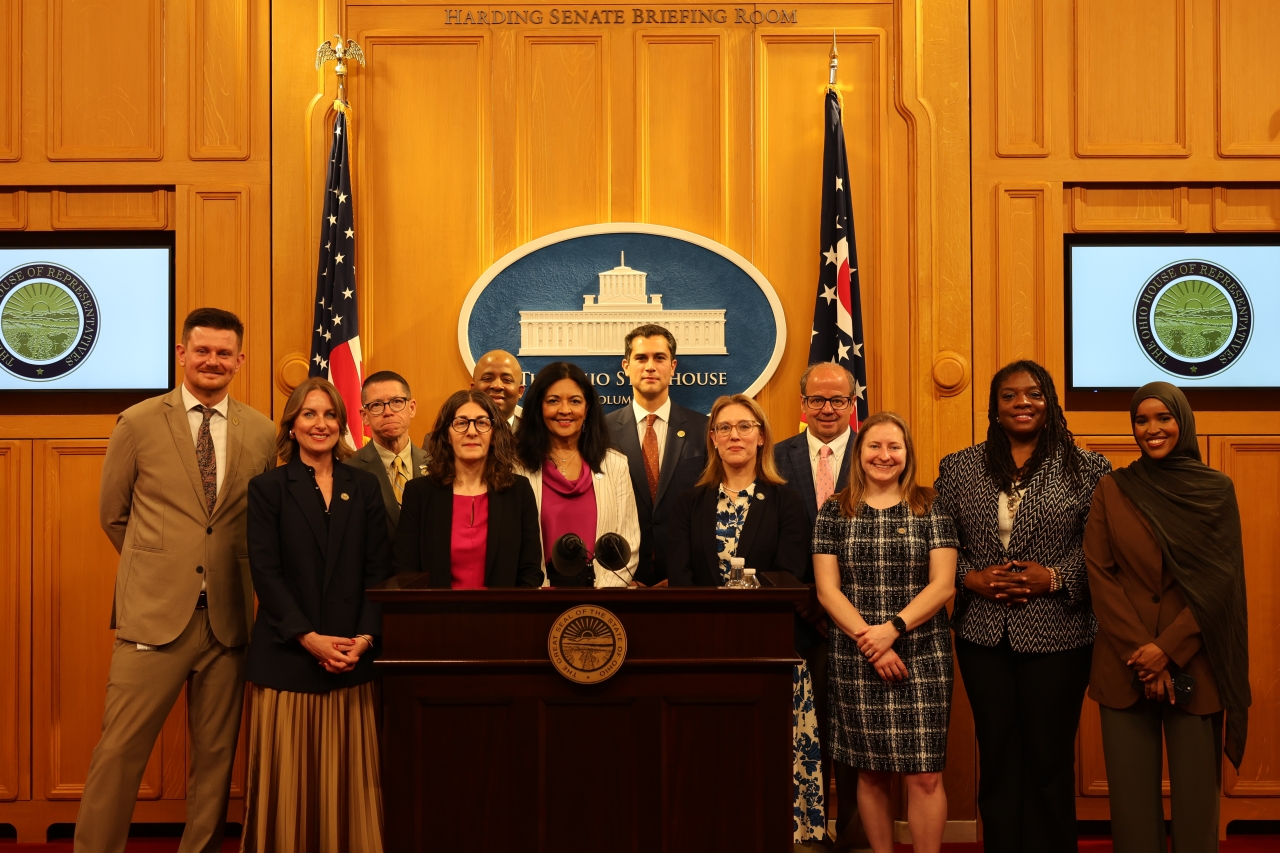
COLUMBUS — Ohio House Minority Leader, Dani Isaacsohn (D-Cincinnati), Assistant Minority Leader Phil Robinson (D-Solon), Minority Whip Beryl Brown Piccolantonio (D- Gahanna), Representative Anita Somani (D- Dublin), Representative Karen Brownlee (D- Symmes Township), Representative Crystal Lett (D- Hilliard), Representative Munira Abdullahi (D- Columbus) and Representative Tristan Rader (D- Lakewood) today unveiled innovative and timely legislation that will reduce Ohioans’ rising healthcare, childcare, energy, housing, and consumer goods costs.
“Ohio is unaffordable because for the last two decades politicians have made it that way,” said Minority Leader Dani Isaacsohn. “To lower costs for normal Ohioans, Democrats are focused on bipartisan, proven policies that will lower premiums, reduce Ohioans’ bills, and rebalance our economy towards the people of our state.”
“Ohioans deserve leaders who find solutions to the problems they need fixed, not leaders focused on helping those at the top continue to do very well.” said Assistant Minority Leader Phil Robinson. “The fact that you can’t afford to buy your first home or keep up with your monthly bills is because of policy choices made in Columbus. Ohioans can’t afford to wait, they need action, and that is what we are proposing today.”
“Ohio used to be the best place in America to raise a family, start a business, and build a good life — but it isn’t any more. Too many Ohioans are struggling to get by. ” said Minority Whip Beryl Brown Piccolantonio. “Ohio Republicans have had control in Ohio for 20 years and have used the time to enrich their donors at everyone else’s expense. Ohio deserves better.”
The Ohio House Democrats announced that they will push “An Ohio You Can Afford” Legislative Package for the rest of this session to make Ohio more affordable. The proposals are outlined with relevant quotes below.
Lowering Healthcare Premiums
For two decades, the politicians in charge in Columbus have chosen insurance companies over patients — blocking Medicaid expansion, refusing to build our own insurance marketplace, and letting coverage get smaller while premiums shot higher. This year, a 60-year-old couple making $85,000 face an $18,000 annual increase.
Today Representative Anita Somani (D- Dublin) announced legislation to establish the Ohio State Reinsurance Program to bring down premiums and stabilize our healthcare system. Seventeen states, led by both Republicans and Democrats, have already done this.
The program works so that once an enrollee's annual medical costs exceed $30,000, the State Reinsurance Program reimburses insurers for 80% of claims up to a maximum cap of $250,000. The result is premium reductions of 28 to 33% for Ohioans buying individual coverage — more than $2,000 in annual savings on a Silver Plan.
This bill funds itself with hundreds of millions in federal matching dollars combined with a 1% assessment on insurance companies. Zero new taxes on Ohio families. “For too long Ohio’s leaders have let premiums rise while coverage got worse” said Representative Anita Somani. “This is a bipartisan policy that has been very successful in other states. Why should premiums in other states come down while ours keep going up? We need to be laser focused on finding the best strategies to lower premiums, and that is exactly what this will do.”
Lowering Housing Costs
For decades, Ohio politicians have made it more profitable for out of state investors to buy up single family homes by the hundreds instead of helping the average family purchase their first home. Today, the median home price in Ohio is at an all-time high. Home sales are at their lowest since 2014. The affordable housing gap in Columbus is worse than New York City or San Francisco.
At the heart of the housing crisis is that supply has not kept up with demand, so rents and home prices have skyrocketed. Since 2019 alone we have lost 62,000 homes that people can actually afford.
Today Representative Karen Brownlee (D- Symmes Township) announced legislation launching a housing construction boom with a $100 million residential development loan program. The funding already exists in the state budget, and won’t require any new funds or incur any additional costs for Ohio taxpayers. The existing fund was designed to fail and has had zero successful applicants. This bill repurposes the funding to actually benefit the people of Ohio.
House Dems propose restructuring the fund to catalyze construction of single-family homes, duplexes and small apartment buildings (up to 20 units), and ADUs. This will be entirely voluntary, only those communities and developers who want to participate. At full capacity, the expanded loan program can support development of more than 2,000 new homes..
“More supply means more competition. More competition means more affordable prices. More affordable prices means more first-time buyers, more stable neighborhoods, more workers able to live near their jobs, and a stronger Ohio economy,” said Representative Karen Brownlee. “With the right policies, Ohio can build its way to a future where owning a home is once again a realistic goal for a working family — not just a dream.”
Lowering Childcare Costs
Ohio Republicans have spent over $1 billion a year on private school vouchers — money that goes overwhelmingly to families already enrolled in private schools — while childcare funding has stayed flat for years. Childcare is the single largest cost for families with children under five. The average cost of childcare in Ohio is over $10,400 a year. To afford that on a single income, you need to earn over $71 an hour. That is not most Ohio families. That is why parents are being
Today, Representative Crystal Lett (D–Hilliard) highlighted legislation introduced by Representative Ashley Bryant-Bailey (D-Cincinnati), the Childcare Tax Credit Act, which creates a refundable state tax credit to help offset childcare costs for working families. The bill provides a $2,000 refundable tax credit per child for families with kids under five. It maxes out at $4,000 for two or more children. Families earn the full credit up to $150,000 a year, with a gradual phase-out above that, so no family hits a sudden cliff.
“Childcare is one of the biggest expenses families face, and too many parents are being pushed out of the workforce because they simply cannot afford it,” said Rep. Ashley Bryant Bailey. “This tax credit puts real money back in parents’ pockets, keeps families in the workforce, and helps Ohio’s economy grow.”
“Republicans have supported childcare tax credits at the federal level for years, and there is no reason Ohio can't lead,” said Representative Crystal Lett. “With the right investment, we can keep parents in the workforce, keep businesses staffed, and stop the $5.3 billion a year in economic losses Ohio is bleeding because childcare is unaffordable. Ohio can and should be a state where a working parent can actually afford to go to work.”
Eliminating Junk Fees
Ohio Republicans have let corporations quietly pick Ohio families' pockets with hidden fees on concert tickets, hotel rooms, utility bills, and everyday purchases The Ohio Attorney General handled nearly 30,000 consumer complaints last year. Consumer Reports estimates junk fees cost the average family of four about $3,200 a year. Representative Munira Abdullahi (D-Columbus) and Representative Michele Grim (D- Toledo) have jointly proposed HB 633, the Fee Transparency Act, which has one simple rule — if a fee is mandatory, it belongs in the advertised price. The price you see should be the price you pay.
This bill does not tell businesses what to charge. It just requires honesty. And it protects the businesses that are already playing fair from being undercut by competitors who hide the real price until checkout.
“This is a straightforward consumer-protection bill: if a fee is mandatory, it belongs in the advertised price. Hidden fees are a tax on trust,” said Representative Munira Abdullahi. “This is not a new or radical idea. President Trump signed an executive order on junk fees in 2025. This is an issue where there is genuine public consensus across party lines — corporations shouldn’t be able to charge secret fees to consumers -- and Ohio should not be the last state to act.”
Lowering Energy Costs
We are in an energy affordability crisis, and it is time for the legislature to step up and do something about it. Ohioans have seen their gas bills increase 84% in the last 3 years. Electric bills are up as much as 60%, averaging between $130-180 each month. At a time of record profits by energy companies and federal mismanagement through PJM, Ohioans need action now.
Representative Rader announced a proposal to provide a $150 annual energy dividend to 5 million Ohioans on their utility bill. The funds will come from a 7% severance tax on the market value of oil and natural gas extracted from our state by energy companies. If that rate was in place last year, we would have generated $665M in revenue. Other states, like Texas (7.5%), Oklahoma (7%), and Kansas (8%) have a similar severance tax already, and Governor John Kasich, a Republican, proposed a 6.5% severance tax in 2015. The Republican Senate Ways and Means Chairman also introduced a similar tax. This is a common sense, bipartisan approach to make sure Ohioans benefit from the profits made from Ohio resources. The time is now for legislators to address one of the biggest drivers of Ohio’s affordability crisis: rising utility bills that continue to strain working families, seniors, and small businesses.
Representative Tristan Rader emphasized that lowering energy costs is not only an economic issue, but a quality-of-life issue.
“The issue is simple. Ohio’s resources belong to the people of Ohio, not multinational energy corporations,” said Rep. Rader. “While families struggle to pay their utility bills, these companies are making record profits. It is time to return that wealth to the people with a direct energy dividend.”
Ohio House Democrats said the package of proposals is part of their broader effort to make Ohio the most affordable, family-friendly state in the Midwest by lowering costs, strengthening household stability, and ensuring the economy works for everyday people.
You can view the press conference here.
EDITOR’S NOTE: A photo from the press conference is attached to this press release. Courtesy: Ohio House Democrats.